The Paint Job on Your Pill: A No-Panic Guide to Colors, Coatings, and Excipients
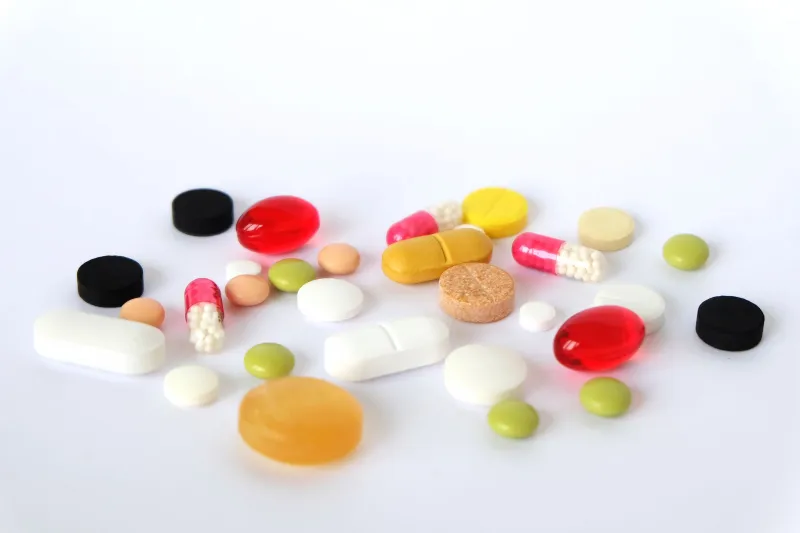
Walk down the supplement aisle at any CVS or Target and you will see the same thing: tablets in blues, pinks, speckled greens, and chalky whites, plus capsules that look like tiny stained-glass windows. It is easy to make fun of the candy-store look. But the ingredients behind that look are not automatically scary, and they are not automatically innocent. They are mostly there for boring manufacturing reasons, with a little branding mixed in.
Excipients Are the Binder, Not the Star
The actual vitamin or mineral is often a tiny fraction of the tablet. The rest is excipients: binders that hold the powder together, fillers that add bulk, disintegrants that help the pill break apart, lubricants that keep powder from sticking to machines, glidants that improve flow, and coatings that protect or mask taste. Magnesium stearate, microcrystalline cellulose, croscarmellose sodium, silicon dioxide, and hydroxypropyl methylcellulose are common examples.
Inactive does not mean irrelevant. Some people react to specific excipients, and some have dietary or religious concerns about gelatin or lactose. But it does mean the ingredient is not intended to be the active treatment. A tablet with no excipients at all would often be impossible to manufacture at a sensible dose.
Color Is Mostly Cosmetic, With a Few Real Tradeoffs
Coloring agents help pills look consistent, distinguish one product from another, and sometimes support adherence. A bright tablet is easier to spot in a pill organizer than a white one. That is a real, if modest, benefit.
The two color-related ingredients that get the most attention are synthetic dyes and titanium dioxide. Synthetic dyes such as Red 40, Yellow 5, Yellow 6, and Blue 1 are FDA-approved for use in foods and supplements. Some research suggests certain children may be more sensitive to dyes, but the evidence is not a blanket verdict that every dye harms every person. In the US, labels must list them.
Titanium dioxide is a whitener and opacifier. The European Union banned it as a food additive in 2022 after regulators raised genotoxicity concerns, and the International Agency for Research on Cancer classifies it as possibly carcinogenic to humans. The US has not followed the EU food ban, and it remains permitted in many supplements. That difference is worth knowing, but it is not proof that a single tablet is dangerous. Dose, particle size, and route matter. If you want to avoid it, look for products that say no titanium dioxide and check the other ingredients line. The replacement may be rice starch, calcium carbonate, or nothing at all.
The Magnesium Stearate Freakout
Magnesium stearate is a lubricant. It keeps powders from gumming up the machinery. Online claims that it creates a biofilm, blocks absorption, or suppresses immune cells are not supported by credible human evidence at the amounts used in supplements. It is usually a very small percentage of the tablet. If you prefer to avoid it, you can find products that use stearic acid, silicon dioxide, or no lubricant. That is a preference, not a safety emergency.
Enteric Coatings: Sometimes Useful, Often Marketing
An enteric coating is designed to survive stomach acid and dissolve farther down the digestive tract. That can be useful for ingredients that irritate the stomach or are degraded by acid. It is not a universal upgrade. For a standard multivitamin, an enteric coating mostly adds cost and may slow breakdown without improving absorption. Delayed release, sustained release, and enteric are not interchangeable phrases, either. If a label leans on a coating as a headline feature, ask what problem it solves.
Dye-Free and Clean Label Are Not Safety Grades
Clean label has no legal definition. Dye-free can mean a product uses beetroot, turmeric, spirulina, caramel color, or no color at all. Natural colorants are not automatically risk-free, and synthetic ones are not automatically toxic. The useful move is to read the other ingredients line, not the front of the bottle.
Third-party testing seals such as USP Verified, NSF Certified, and Informed Choice are more useful than color claims. They generally speak to identity, potency, and contaminants, not to whether a dye is right for you.
A Practical Way to Judge the Bottle
Ask three questions. Does the color or coating serve a purpose you care about, such as identification or stomach comfort? Are you specifically trying to avoid a listed ingredient, such as a dye, titanium dioxide, gelatin, or lactose? Is the product third-party tested, and is the price premium for clean label buying you something more than marketing?
A white tablet is not automatically cleaner, and a brightly colored one is not candy. It is a manufactured object with functional ingredients, cosmetic choices, and a label you can read. In 2026, that is still the best tool in the aisle.